25 Days | Exclusive Escorted Tour
Departs Saturday 9th October 2027
Egypt & Kenya: An Egyptian Awakening and The Magic of Kenya
There are some places we know long before we ever visit them.
The pyramids of Giza. The Sphinx. Tutankhamun. The temples of the Nile. Elephants crossing an African savannah beneath the distant silhouette of Mount Kilimanjaro.
Their images have become part of our collective imagination – yet seeing them for the first time is something altogether different.
The Compass Society’s Egypt & Kenya journey, departing 9 October 2027, brings together two extraordinary chapters of Africa in one carefully designed 25-day escorted experience.
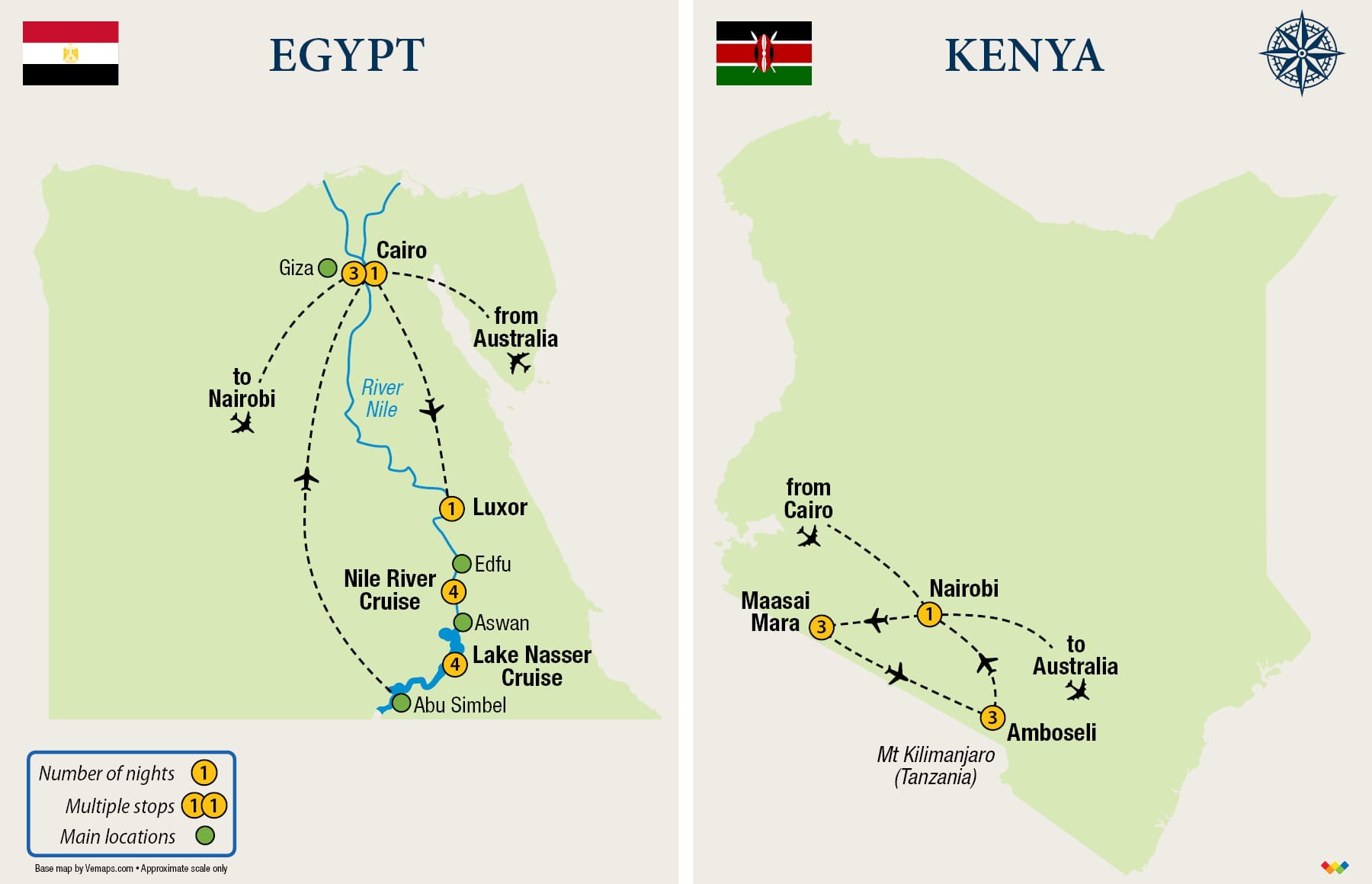
For the first part of the journey, we travel deep into the story of ancient Egypt – from the earliest experiments in pyramid building at Saqqara and Dahshur to the monumental achievements of Giza, Luxor and Abu Simbel. We follow the Nile south, first aboard a luxury river cruise and then across the vast, remote waters of Lake Nasser, discovering temples, tombs and landscapes that span thousands of years.
Then the rhythm changes completely.
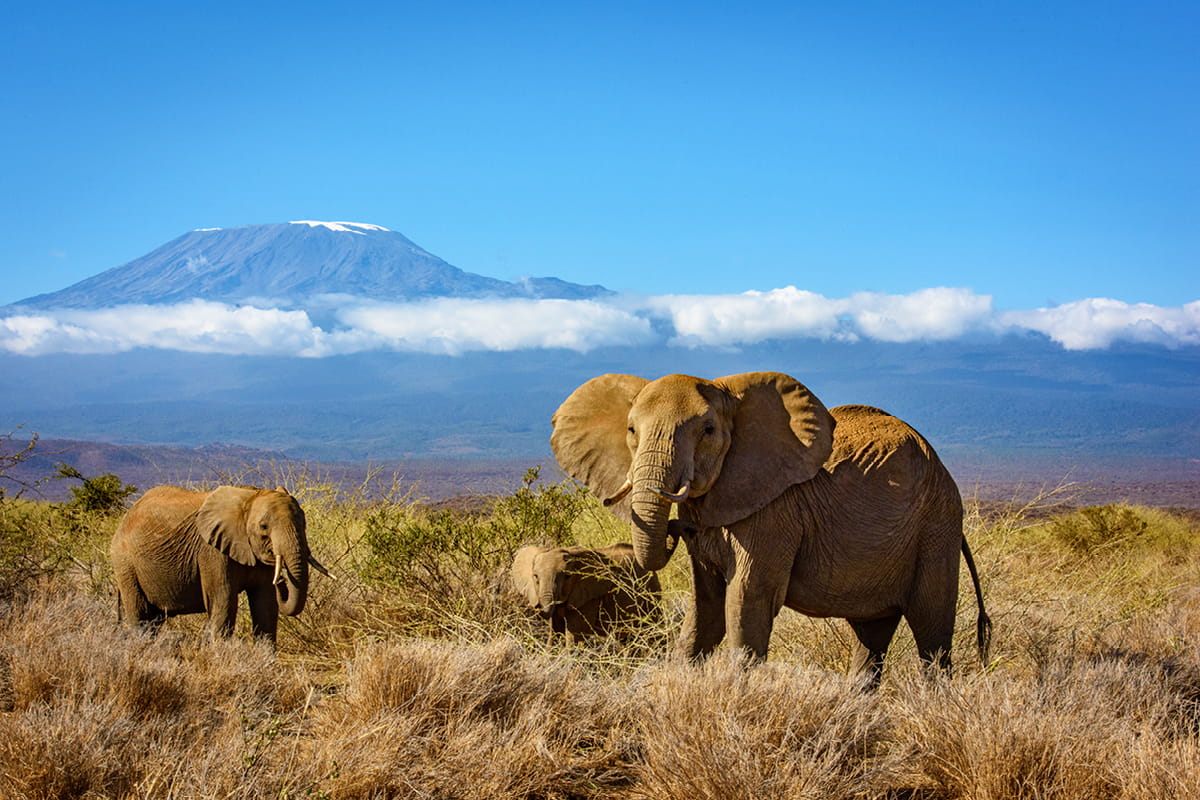
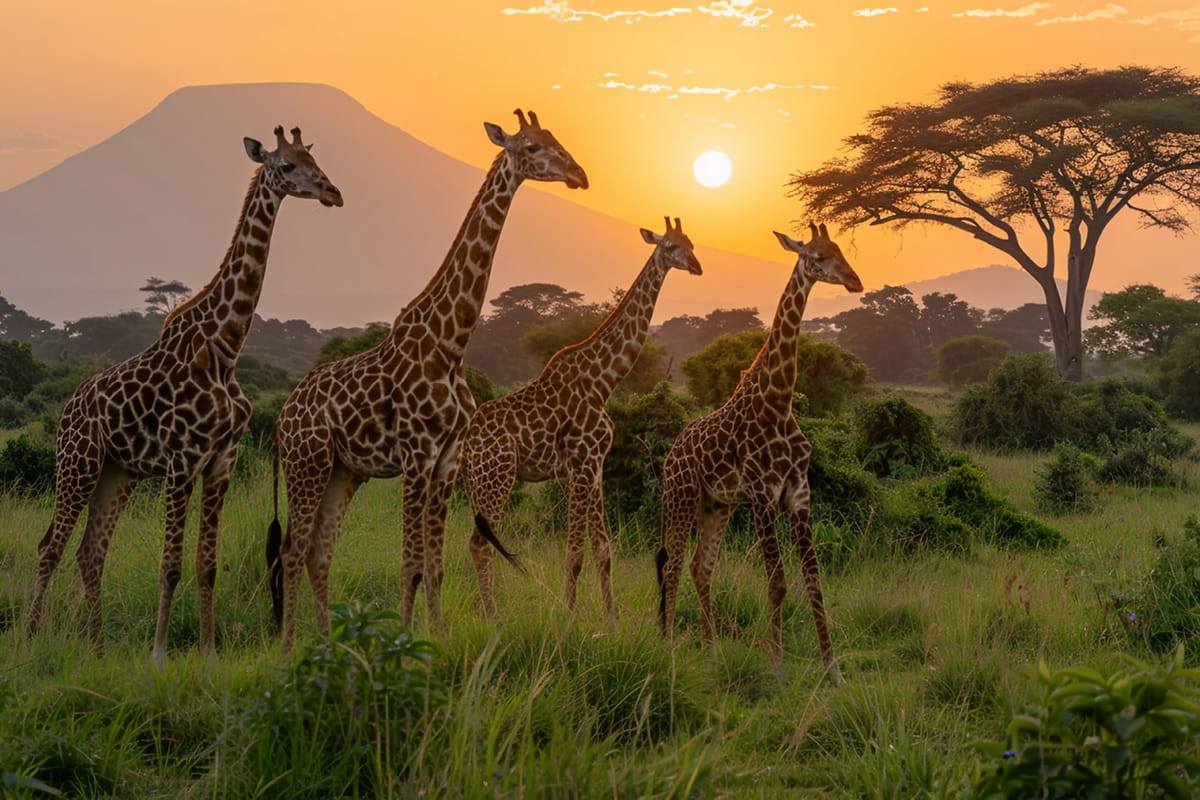
Ancient stone gives way to open savannah. Temples and pharaohs give way to elephants, giraffes, lions, leopards and the great landscapes of Kenya. We fly into the Maasai Mara for days of safari before continuing to Amboseli, where some of Africa’s great elephant herds roam beneath Mount Kilimanjaro.
It is a journey of remarkable contrasts — but also one connected by something deeper: the opportunity to encounter two very different expressions of Africa with the time and space to appreciate them properly.
Where the story of monumental Egypt begins
Our Egyptian story does not begin at the Great Pyramid.
Instead, we travel further back – to the extraordinary period when ancient Egyptian builders were first discovering how to create monumental architecture in stone.
At Saqqara we stand before the Step Pyramid of Djoser, one of Egypt’s earliest monumental stone structures and an important precursor to the pyramids that would follow.
Nearby at Dahshur, the Bent Pyramid and Red Pyramid reveal another fascinating stage in that evolution. Seen together, these structures allow us to follow something quite remarkable: not simply a collection of ancient monuments, but the development of an idea.
Experiments in engineering gradually became mastery. That context makes what follows even more powerful.
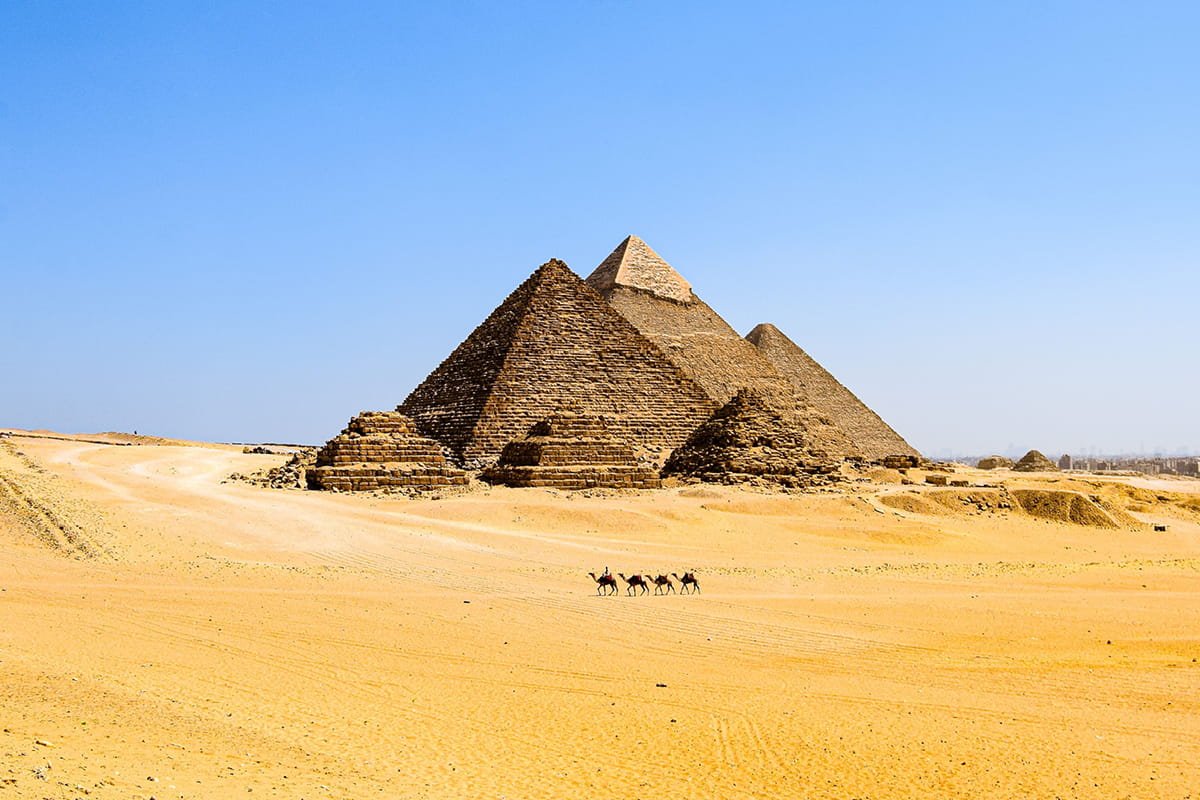
The next day brings us to the Giza Plateau, where the Great Pyramids rise from the desert as they have for approximately 4,500 years. Nearby is the enigmatic Sphinx, carved directly from the limestone bedrock.
These are monuments so familiar from photographs, books and documentaries that it can be difficult to imagine the scale of encountering them in person.
And yet Giza is only part of the story.
The day continues at the Grand Egyptian Museum, where thousands of artefacts help reconnect the monumental scale of ancient Egypt with the people, craftsmanship, beliefs and lives behind it – including the glittering treasures associated with Tutankhamun and the ancient Solar Boat created for Pharaoh Khufu.
Luxor and the ceremonial heart of ancient Egypt
A short flight south takes us to Luxor and into another great chapter of Egyptian history.
Here, ancient Thebes once stood at the centre of political and religious life.
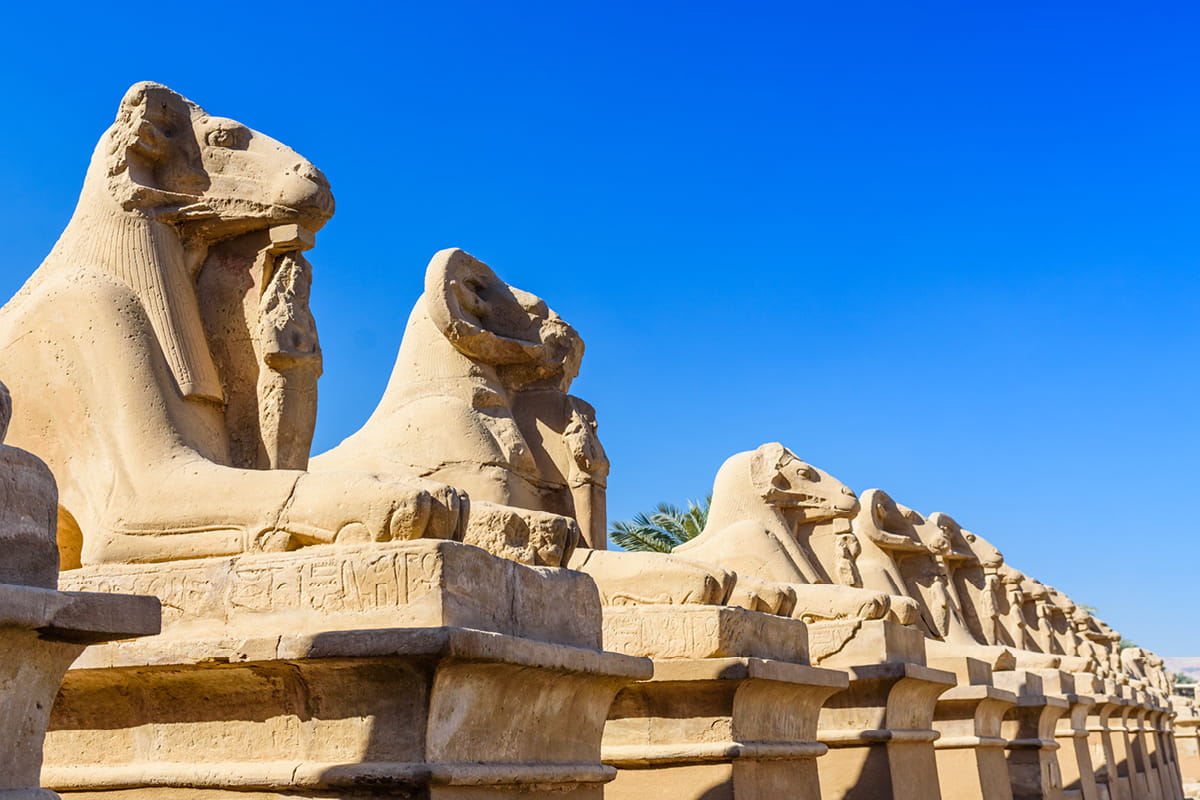
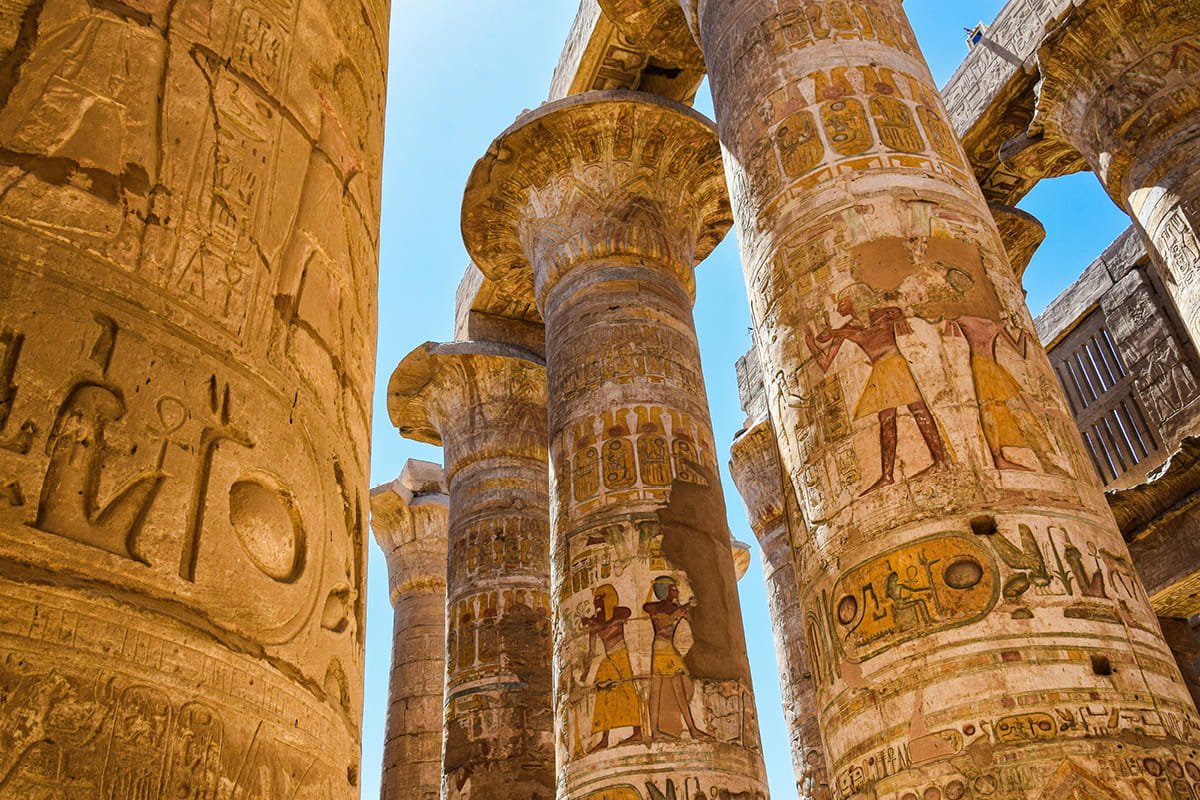
At Karnak Temple, centuries of building created an immense complex of sanctuaries, pylons, statues and towering columns. It is not one monument created at one moment, but a place continually shaped by generations of rulers.
Later, we visit Luxor Temple as the sun begins to set – a particularly atmospheric time to experience a place associated with royal ceremony and coronation for centuries.
The following morning takes us across the Nile to the West Bank and the Valley of the Kings.
Here, hidden within the desert landscape, pharaohs created elaborate rock-cut tombs intended to protect their journey into the afterlife. Our visit includes access to three tombs as well as special entry into the tomb of Tutankhamun, where the young pharaoh’s body remains.
We also visit the striking mortuary Temple of Queen Hatshepsut, one of ancient Egypt’s most successful female rulers, together with the Colossi of Memnon and the Ramesseum.
It is an extraordinary concentration of history – but from here, the pace begins to change.
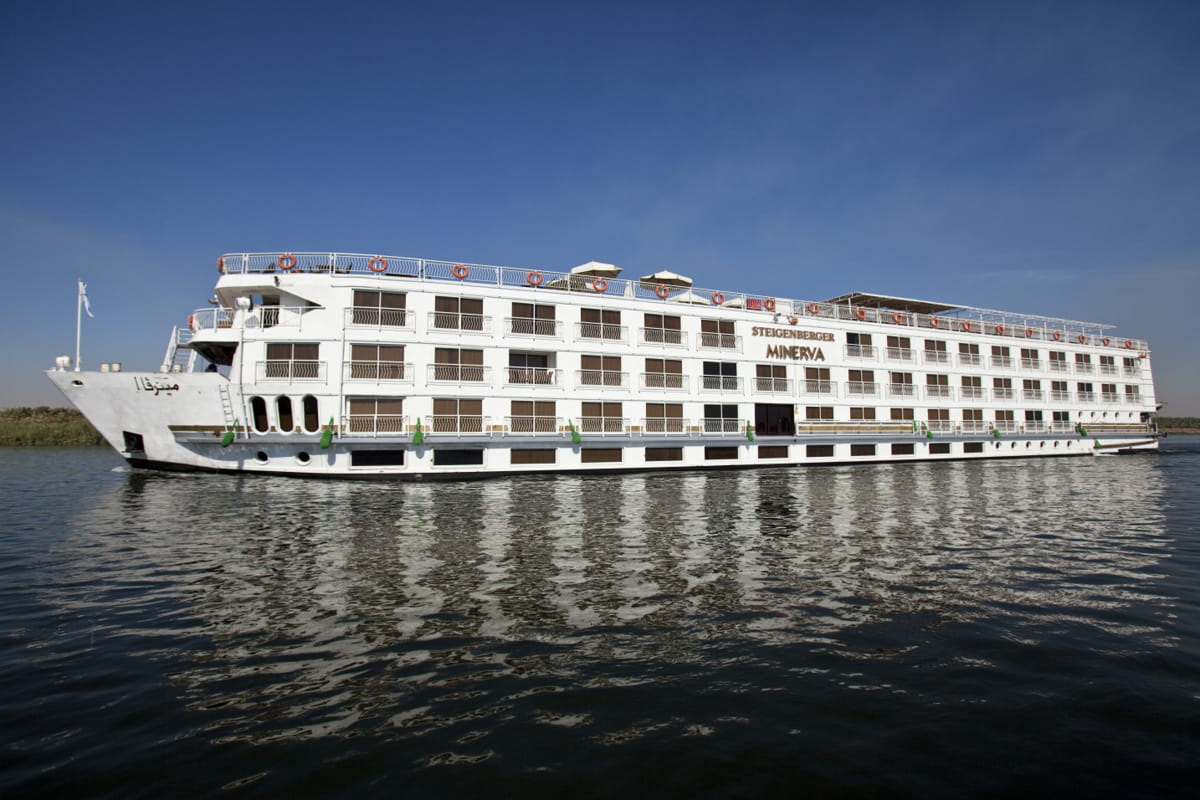
We board the MS Minerva and allow the Nile itself to carry us into the next part of the journey.
Following the Nile south
There is something particularly appropriate about discovering Egypt from the river.
For thousands of years, the Nile has been the country’s great artery – sustaining agriculture, connecting communities and providing a route through landscapes that would otherwise be dominated by desert.
Our four-night cruise from Luxor to Aswan gives us the opportunity not only to visit important archaeological sites, but also to experience the quieter rhythm of life along the river.
One day is devoted largely to sailing, watching the Egyptian countryside pass from the deck as we make our way through the historic Esna Lock towards Edfu.
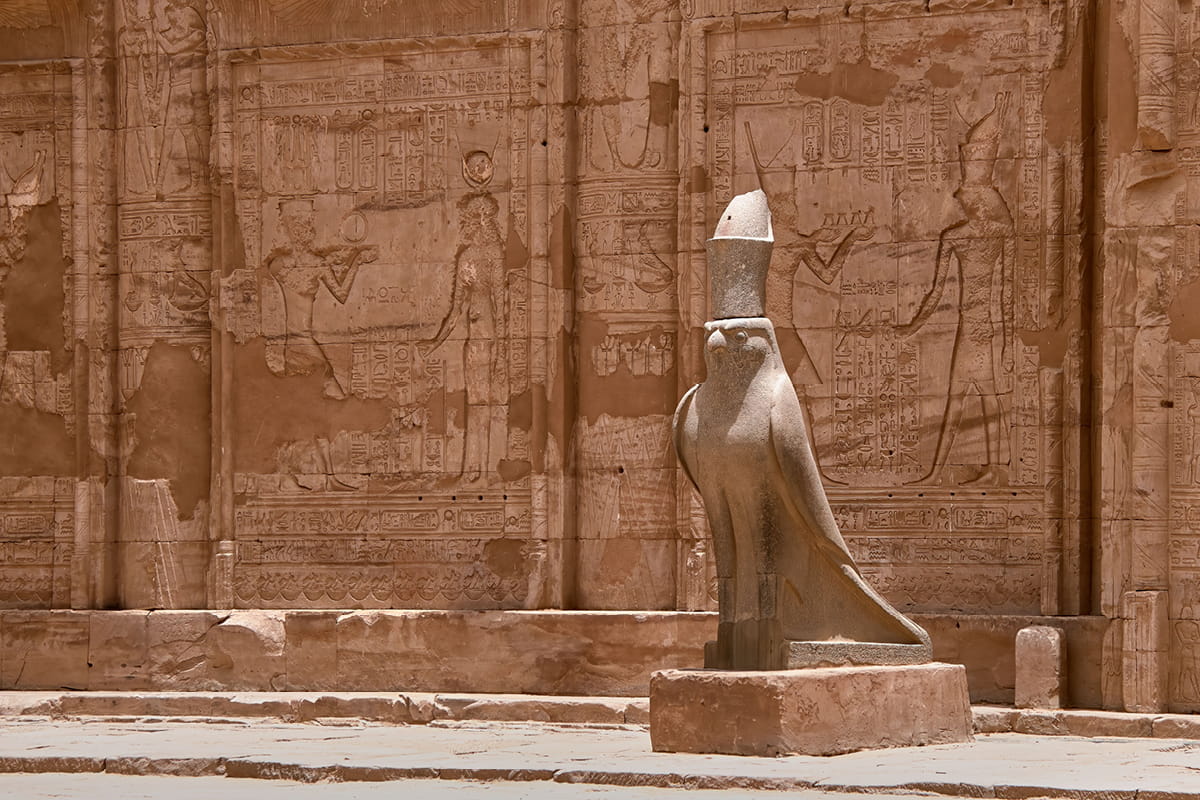
At Edfu, we visit the remarkably preserved Temple of Horus, one of the most complete ancient temples in Egypt. Further south, Kom Ombo presents something quite different: an unusual double temple overlooking the Nile, dedicated to two deities – Sobek, the crocodile god, and Horus the Elder.
By the time we reach Aswan, the landscape and atmosphere have changed again.
Here we visit beautiful Philae Temple, dedicated to the goddess Isis and rescued from the rising waters created by the Aswan High Dam.
Later, we leave our larger vessel behind for something much simpler – a traditional felucca.
With its distinctive triangular sail catching the wind, the felucca offers a wonderfully timeless way to experience the Aswan Cataracts. For a while, the machinery of modern travel disappears and we move across the Nile in much the same way travellers and traders did for centuries.
Beyond the familiar Egypt: Lake Nasser
For many travellers, Aswan might mark the end of a conventional Nile journey.
For us, it opens another chapter.
We leave our Nile cruise and board a smaller boutique vessel for four nights on Lake Nasser, travelling through the ancient lands of Lower Nubia.
This part of the journey has a distinctly different character.
The landscapes become broader and more remote. Deep blue water meets stark desert shores, while isolated archaeological sites appear along the lake – monuments that survived one of the most extraordinary international heritage rescue efforts of the 20th century.
The construction of the Aswan High Dam threatened to submerge numerous ancient sites. Temples were painstakingly dismantled, moved to higher ground and reconstructed, preserving them for future generations.
We visit Kalabsha Temple and the rock-cut Bait el-Wali, followed by Wadi el-Seboua with its striking avenue of sphinxes.
At Amada, we discover the oldest surviving Egyptian temple in Nubia, whose relatively modest exterior gives little indication of the remarkably preserved reliefs within.
Travelling between these sites by water brings a sense of scale that is difficult to appreciate in isolation. The temples become part of a larger story – of ancient Nubia, modern engineering, archaeological preservation and a landscape dramatically reshaped within living memory.
And ahead lies one of Egypt’s greatest sights.
Abu Simbel: monumental even by Egyptian standards
After nearly two weeks following Egypt’s story south, the Lake Nasser voyage culminates at Abu Simbel.
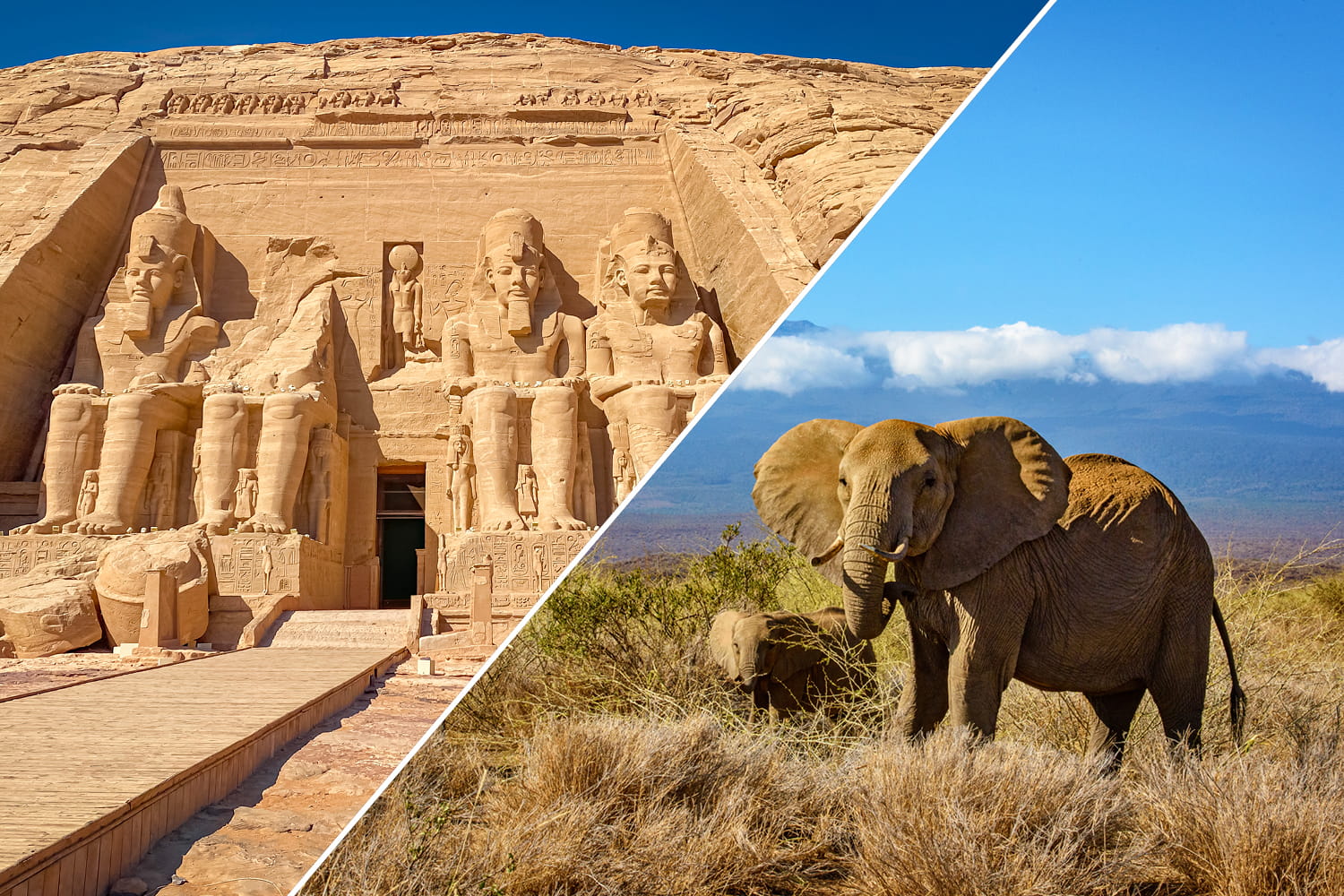
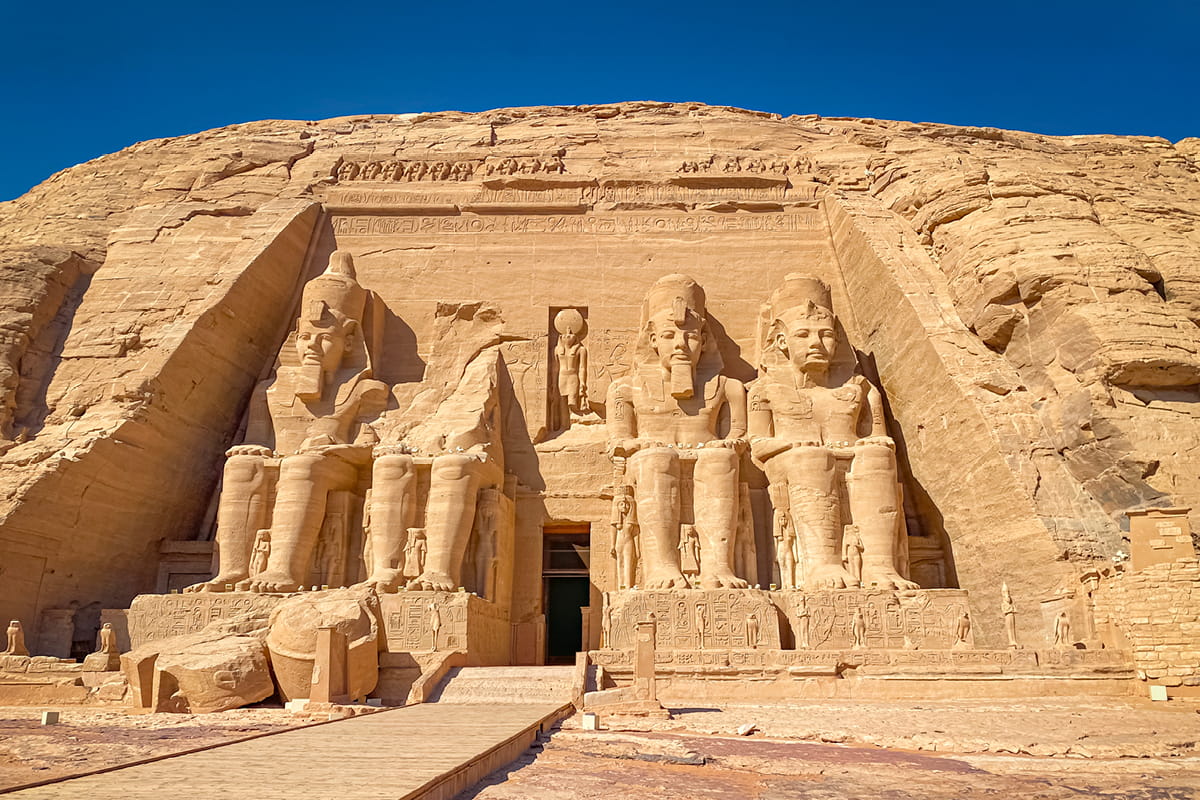
Carved into sandstone cliffs during the reign of Ramesses II, the two temples are among the most commanding monuments of ancient Egypt.
Four colossal seated figures of Ramesses II guard the Great Temple, while the neighbouring temple honours Queen Nefertari.
The scale alone is extraordinary.
Yet Abu Simbel carries another remarkable story. When the creation of Lake Nasser threatened the temples, the complex was carefully cut into enormous blocks and reconstructed on higher ground – an extraordinary feat undertaken to save it from inundation.
Our visit allows time to explore the temples and their decorated interior chambers before returning in the evening for the Sound & Light Show, when the monumental façades are illuminated against the darkness of the Nubian desert.
It provides an atmospheric finale to our journey through southern Egypt.
But Egypt still has one final encounter waiting for us.
Back in Cairo, we visit the National Museum of Egyptian Civilization, including its extraordinary Royal Mummies Hall, before entering the colour, energy and labyrinthine lanes of the centuries-old Khan el-Khalili Bazaar.
Then, after almost two weeks immersed in the world of pharaohs, temples and the Nile, we fly overnight to Nairobi.
And Africa changes around us.
From the ancient world to the living wild
The transition from Egypt to Kenya is one of the qualities that makes this journey so distinctive.
In Egypt, much of what we encounter asks us to look backwards across thousands of years.
In Kenya, the experience is vividly alive and unpredictable.
Our introduction begins in Nairobi with three very different encounters.
At the Sheldrick Wildlife Trust, we meet rescued orphaned elephants and learn about the work undertaken to protect and rehabilitate them.
At the Giraffe Centre, endangered Rothschild’s giraffes bring us quite literally face-to-face with another of Africa’s most distinctive animals.
And at the Karen Blixen Museum, the former farmhouse of the author of Out of Africa offers a human and literary connection to Kenya’s past.
Then it is time to leave the city behind.
Into the Maasai Mara
We fly into the Maasai Mara National Reserve, where our canvas accommodation at Mara Maisha Camp becomes our base for three nights.
This is the Africa of enormous skies, grasslands stretching towards the horizon and wildlife moving freely across a vast natural stage.
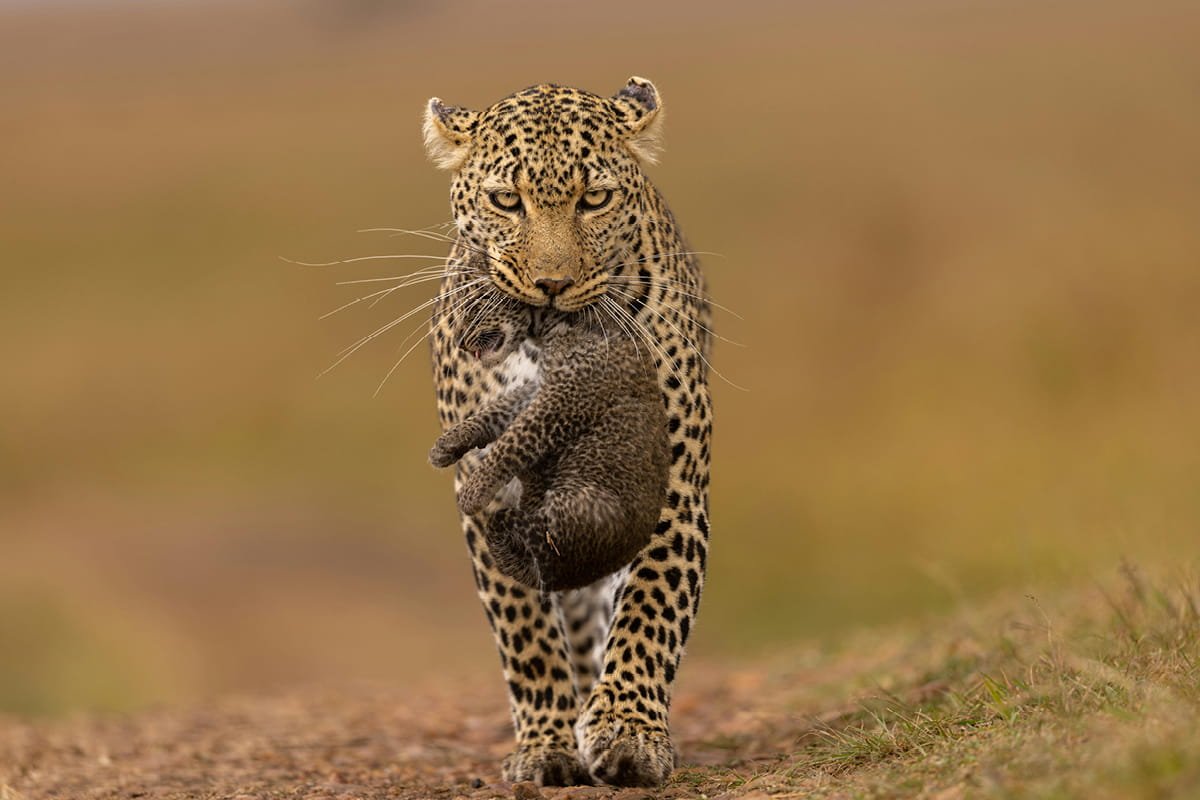
Morning and afternoon game drives take us into the reserve in search of the legendary Big Five – lion, leopard, rhinoceros, elephant and buffalo – along with cheetahs, hippos, zebras, wildebeest and abundant birdlife.
But safari is about much more than ticking animals from a list.
Every drive is different.
A distant shape in the grass may become a lion. A quiet waterhole may suddenly reveal hippos. A herd may begin to move across the plains. Predators and prey continually respond to one another, while guides read tracks, behaviour and landscape for clues about what may be nearby.
One morning adds another very Compass Society moment: after our game drive, a private bush breakfast is prepared in the wilderness, ideally beside a river where resident hippos may provide rather memorable company.
It is the kind of experience that reminds us to stop, look around and simply enjoy where we are.
Elephants beneath Kilimanjaro
From the Maasai Mara, we fly onwards to Amboseli National Park.
If the Mara is defined by the great sweep of its savannah, Amboseli has an unmistakable presence on its horizon: Mount Kilimanjaro.
Africa’s highest mountain actually stands across the border in Tanzania, yet its snow-capped summit provides one of Kenya’s most celebrated landscapes.
Amboseli is particularly famous for its elephants, and we have two full days of morning and afternoon game drives to explore the park.
Here, large elephant herds move through a landscape of open plains, wetlands and acacia woodland, sometimes with Kilimanjaro rising beyond them.
After the temples, tombs, columns and colossal statues of Egypt, there is something wonderfully elemental about ending the journey here.
Nothing is staged.
The animals determine the encounters. The light changes. The mountain may reveal itself or disappear behind cloud. Each game drive has its own possibilities.
That unpredictability is part of the magic.
Two very different Africas, one extraordinary journey
Egypt and Kenya could easily stand alone as remarkable destinations.
Bringing them together creates something richer.
We begin by tracing human achievement across thousands of years – from the earliest pyramids to the great monuments of Giza, the temples of Thebes, the tombs of pharaohs and the rescued treasures of Nubia.
We travel by river through the landscapes that made Egyptian civilisation possible, then venture beyond the familiar Nile itinerary onto the remote waters of Lake Nasser.
And just when we have become immersed in antiquity, the journey transforms.
Suddenly our attention turns from what humanity left behind to the extraordinary natural world still unfolding around us.
Stone gives way to savannah. Pharaohs give way to elephants. The measured silence of ancient tombs gives way to the anticipation of a morning game drive.
Yet both parts of the journey share the same underlying idea: to experience a place with enough time, context and curiosity for it to become more than a collection of famous sights.
Travelling with Cathi and The Compass Society
As with every Compass Society journey, the itinerary is only part of the experience.
Cathi Burnett-Cosgrove brings more than 40 years of travel experience to the journeys she designs and escorts. Her approach has never been simply about fitting as many sights as possible into a tour. It is about how those experiences connect – the rhythm of the journey, the people travelling together, the distinctive moments along the way and the opportunity to experience somewhere beyond its surface.
This Egypt & Kenya journey reflects that approach beautifully.
There are unquestionably great icons: the Pyramids of Giza, Tutankhamun, Karnak, the Valley of the Kings, Abu Simbel, the Maasai Mara and Kilimanjaro.
But between them are the experiences that give the journey its texture – sailing the Nile, crossing Lake Nasser, gliding around Aswan by felucca, encountering remote Nubian temples, meeting rescued elephants, sharing a bush breakfast and heading out together each morning wondering what the African wilderness might reveal.
With a maximum of just 11 guests, it is also a genuinely small-group experience, designed for travellers who appreciate thoughtful planning, good company and the reassurance of travelling with an experienced escort throughout.
Twenty-five days after leaving Australia, we return having travelled through worlds that could hardly be more different – yet somehow belong beautifully together.
An Egyptian awakening, followed by the magic of Kenya.
Optional Post-Tour Extensions
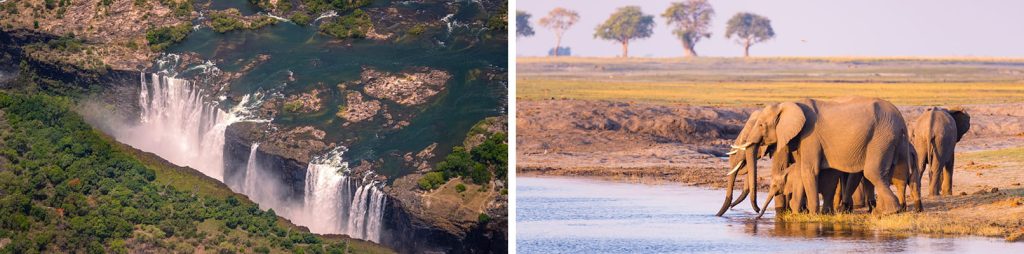
Enhance your African journey with our exclusive optional extensions to the breathtaking Victoria Falls, or combine the falls with an unforgettable wildlife safari in Chobe National Park.
Detailed pricing and tailored itineraries are available upon application: contact Cathi to find out more.
Tour Highlights include:
- Stand before the ancient Step Pyramid of Djoser at Saqqara, one of Egypt’s earliest monumental stone structures.
- Explore the legendary Great Pyramids of Giza and the enigmatic Sphinx.
- Visit the spectacular Grand Egyptian Museum, home to thousands of artefacts and the treasures of Tutankhamun.
- Discover the ceremonial heart of ancient Thebes at Karnak Temple and Luxor Temple.
- Cross to the West Bank to explore the Valley of the Kings, including special entry to the tomb of Tutankhamun.
- Visit the dramatic Temple of Queen Hatshepsut, the Colossi of Memnon and the Ramesseum.
- Cruise the Nile from Luxor to Aswan, taking in temples, river life and timeless desert landscapes.
- Discover the beautifully preserved Temple of Horus at Edfu and the waterside double temple of Kom Ombo.
- Sail by traditional felucca around the Aswan Cataracts.
- Journey across remote Lake Nasser, where ancient temples rise from dramatic desert shores.
- Explore the rescued Nubian temples of Wadi el-Seboua, Dakka, Maharraqa and Amada.
- Experience the grandeur of Abu Simbel, including an atmospheric evening Sound & Light Show.
- Visit Cairo’s National Museum of Egyptian Civilization and the evocative Royal Mummies Hall.
- Wander the bustling lanes of Khan el-Khalili Bazaar before continuing to Kenya.
- Meet rescued orphaned elephants at the Sheldrick Wildlife Trust and hand-feed endangered Rothschild’s giraffes at the Giraffe Centre.
- Visit the historic Karen Blixen Museum, forever linked with Out of Africa.
- Fly into the iconic Maasai Mara for immersive 4×4 safari drives across the savannah.
- Search for Africa’s legendary Big Five alongside cheetahs, hippos, zebras, wildebeest and abundant birdlife.
- Enjoy a private bush breakfast in the wilderness.
- Conclude with the unforgettable landscapes of Amboseli National Park, famed for elephant herds set against the backdrop of Mount Kilimanjaro.
- Return international flights from Hobart, domestic flights in Egypt and Kenya, 52 included meals and much more.
Why Travel With The Compass Society
Being part of a small, escorted group means you leave home with an experienced personal escort — and someone who understands travel inside and out.
With over 40 years of first-hand experience, Cathi Burnett-Cosgrove ensures that every detail is cared for and every moment meaningful. You’ll meet your fellow travellers before departure, share unforgettable experiences throughout the journey, and return home with new friends and memories that last a lifetime.
Cathi’s thoughtful approach to travel design goes beyond ticking boxes — it’s about depth, connection, and authenticity. From the intricate details of itinerary planning to the personal warmth that shapes each day, this journey captures the very essence of The Compass Society: travel that enriches both the heart and the mind. You can also read what others say about their experience with Cathi on previous Compass Society journeys.
What to Do Now
Ready to explore Egypt and Kenya with The Compass Society?
- Click the button below to download our full tour itinerary, or
- Contact Cathi Burnett-Cosgrove for bookings and enquiries.